After the British loss at Yorktown, the government led by Lord North collapsed in a Parliamentary vote of no confidence. The sitting members of Parliament communicated to King George III that they no longer had faith in the Prime Minister to effectively set policy. In representative government, the mandate to lead comes, directly or indirectly, from the led. I’ve been thinking lately that it’s a pity we don’t see the application of no confidence motions in more places. If we learned anything from the unfortunate case of Lord North (and from Braveheart), it’s that men don’t follow titles. Sure, they’ll go along for a while – as long as things are going well or as long as they don’t have options. But the moment they lose confidence or when a better opportunity presents itself, their support for your mandate to lead will fade away like a mist. You’ll look around one day and find yourself alone with your bad decisions, resented for your presumption of unearned loyalty, and ultimately made as irrelevant as the rock the water in a stream simply flows around.
Tag Archives: history
Being Sherman…
During the Civil War, one of the greatest partnerships in American military history was forged here along the muddy waters of the Mississippi. The senior partner would become commander of the Army of the Potomac and bring Lee’s Army of Northern Virginia to its knees in a grinding war of attrition, while the junior partner marched his battle hardened western armies south to Atlanta and on to the sea, making the Old South howl.
From camp near Memphis on March 10, 1864 and just after Grant was called to Washington and promoted to command all Federal forces, his old friend Sherman sent a memo of congratulations that read, in part, “…You go into battle without hesitation… no doubts, no reserve; and I tell you that it was this that made us act with confidence. I knew wherever I was that you thought of me, and if I got in a tight place you would come – if alive.”
If you’re very lucky, you’ll find such a colleague and friend once in a career. If you’re even luckier, you get your chance at being Sherman.
Date and Places
It would be easy to spend the day wallowing around in the news coverage of the 9th anniversary of the September 11th attacks, but I’ve actually done my best to stay away from that today. Sure, I paused and reflected about where I was, where we were, and what we’ve become since then. I’m starting to see how our parents generation can point to the time before President Kennedy’s assassination as seeming to be more innocent. Hindsight does that, it seems; rounds off the sharp edges and gives things past the soft glow of a Norman Rockwell painting.
The world was a violent place long before September 11, 2001 and it will be violent a thousand Septembers from now. Even knowing that, there will never be an anniversary of this date that doesn’t drag me back to the memories of that morning – to the shock, the disbelief, the anger, and the pure raw hatred of those few who came here to attack us on a crystal clear September morning. History usually dulls some of the feeling in telling the story of the past. Maybe too few years have passed or perhaps this is one of those memories you keep with stark clarity for the rest of your life. In any case, it’s been a tough one – even without the accompanying chatter of the media.
Convoy…
Yesterday, what the media are calling the last American combat convoy left Iraq. That draws down the force in being to something  a little larger than 50,000, from one at its peak hovered around the 140,000 mark. Seven years is a long time, particularly for a country that can be challenged by paying attention to a 30 minute television show.
For someone who has spent most of his life fascinated by history, just the phrase “last convoy” brings to mind certain imagery. Watching the Strykers lumbering across the Iraqi desert, it’s hard not to conjure up images of the final Soviet personnel carriers crossing out of Afghanistan or the iconic picture of the Huey evacuating CIA operators from a downtown rooftop during the fall of Saigon.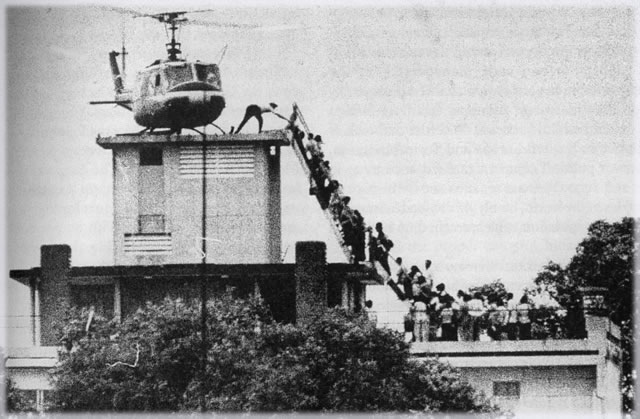
In every case, there’s something unsettling about the scene – something unfinished. We seem to be pathologically hard wired to demand an ending to every story or to expect that some final grand gesture will bring closure. Study history long enough and you come to the conclusion that nothing ever really ends it just becomes part of our collective past and informs the future in the same way that Vietnam informed the Soviets in Afghanistan and both influeced how we did and didn’t behave in Iraq. Eventually, and probably sooner rather than later, the Iraq experience will inform whatever comes next. And history sweeps on towards the next last convoy.
If you can keep it…
One of the quotes often ascribed to Ben Franklin tells of him responding to a question asked about what type of government there would be for the United States. Franklin responds that it’s a democracy, if we can keep it. This weekend we rightly celebrate our country’s birth announcement. But in doing this, so many forget the terrible price that was paid “to keep it” well beyond the surrender at Yorktown and the Treaty of Paris.
On July 3, 1863 Confederate forces inside the besieged city of Vicksburg, Mississippi sued for peace and laid down their arms. Earlier in the afternoon, on a field in Pennsylvania, the flower of Lee’s Army of Northern Virginia shattered themselves against the Union center at Gettysburg; all but guaranteeing the eventual southern defeat. These twin victories, announced to the world on July 4th, 1863, ensured that the visionary experiment in democracy laid down in 1776 would endure even the bloody nightmare of civil war.
We owe much to the founders who gave us our republic, but so too do we owe a debt of gratitude to the men of 1863, who fought and died to preserve what their grandfathers and great grandfathers and built. As it was in 1776 and in 1863, so it is now – This Union, this republic, must be preserved against any, domestic or foreign, who rise against it.
Farewell to an American Hero
It’s no secret that the generation that came of age in the Depression and were tempered on the anvil of World War II are dying. The youngest of them are now in their 80s. Within the next 20 years, the war will have passed out of living memory to become the sole province of the historians.
I was once privileged to meet an American hero is the truest sense of the word. Slight in build and clearly feeling his years, I was able to spend a few moments simply talking with Paul Tibbets, who piloted Enola Gay on August 6, 1945. Even when we talked, some 60 years after the event, Mr. Tibbets made no apologies for leading his mission that day. His body was bent with age, but looking in his eyes, you simply knew this was a man who was at peace with himself and who was assured of the rightness of his actions and his cause.
Paul Tibbets was a man who answered his nation’s call, did is duty, and returned home to help remake a global system shattered by war. The Director of the National Aviation Hall of Fame best eulogizes him in saying, “There are few in the history of mankind that have been called to figuratively carry as much weight on their shoulders as Paul Tibbets… Even fewer were able to do so with a sense of honor and duty to their countrymen as did Paul.”
Columbus Day…
You know what? Chris Columbus wasn’t perfect. He did some bad things. He also had the courage to climb aboard a hundred foot wooden ship and sail 2500 miles into an ocean that was more or less uncharted. Looking for a trade route to the Indies, he landed in the Americas and opened two continents to further exploration and began the largest age of migration in all of human history.
I’ve watched a number of reports this morning condemning Columbus as a genocidal maniac and all I can do is shake my head in frustration. I will never understand why educated people insist on applying 21st century morality to 15th century actions. Of course if we “discovered” an unknown continent tomorrow, we wouldn’t approach it the same way that Columbus did in the 1490s. We wouldn’t approach it the same way the Great Powers of Europe approached Africa in the 19th century, either. We would approach it using our best judgment based on 21st century understanding of peoples and our “improved” sense of morality. And 500 years from now, we would probably be criticized for our actions because they were not how those “future” observers would handle the situation.
Columbus is roundly criticized because he “didn’t even know he was in America.” Of course he didn’t know he was in America (aside from the continents actually not being called America at that point). Up until that point, perhaps a relative handful of Europeans had ever set foot on the continent and most of those did so in the extreme north. There were no accurate maps, no global positioning systems, and actually no way to even accurately establish longitude. And still, for God and glory, Columbus captained three fragile ships to a new world.
I won’t become an apologist for history. The history is what it is. Actions were not all good, nor all bad. They simply are what was done at the time. While Columbus legacy is clearly “mixed,” I have no qualms about celebrating him as an iconic figure in our history.
Seven Hills…
Note: This post is based on notes I made on Wednesday, April 4. 2007 in Rome.
What we had was more an assault on the Eternal City than a tour… a nine hour mad dash across the city that took us from the Vatican Museums to the Sistine Chapel and Mass in St. Peter’s Square, and to the Coliseum, Forum, Pantheon, Trevi Fountain, and the Spanish Steps. There is so much history here… Where republican values were institutionalized in the West as well as where those ideals were lost for a millennium. Where empire was born out of civil war and the words of Cicero moved the world. Into the Forum Romanum, where victorious commanders were awarded their triumph down the Sacred Way into the Forum to the Capitoline. 2500 years of human history have passed this single spot.
The feeling one gets standing at the steps of the Curia, the old Senate house, or under the Arch of Titus looking down over the Forum are simply indescribable. Perhaps it’s simply my abject love of all things old, but it’s something like standing on a beach at night looking out at the dark sky bleeding into the even darker water and seeing the stars. You realize your own smallness against the backdrop of the universe. It’s an overwhelming feeling of awe and mixed with profound sadness at standing on the ruined remains of the ancient world’s sole superpower. It’s a striking reminder that all things pass in their time. Still, there is something overwhelmingly grand about Rome. Eternal City just about covers it.
Portrait of Pompeii…
Note: This post is based on notes I made on April 2, 2007 in Pompeii and Naples.
Pompeii is one of those places that by right really shouldn’t exist. The city was lost to the Romans in 79 BC and forgotten by the world until the mid-18th century. Covered in yards of ash, the city lay completely preserved until the advent of modern archeology. We know more about life in the empire because of Pompeii than any other place that has been excavated to date. Today’s Pompeii adjoins the modern city of Naples, which itself stands in the shadow of Vesuvius. The city itself is remarkable… homes, businesses, and temples all still stand and aside from the roofs which burned off or collapsed in the ash fall look as though ready for their owners, patrons, and priests to return.
We clean up after natural disasters; rebuild after hurricanes and clear away the rubble from earthquakes. New Orleans, one of America’s great port cities, was decimated by a hurricane. Whole sections of the city were lost. Pompeii, on the other hand, would be more akin to the storm surge sweeping ashore and the water never receding back into the Gulf. There are physical reminders of the people of Pompeii; plaster casts made from the void left where they fell on the street in a futile effort to flee. More poignant are those who knew their fate and cowered in a corner to await the inevitable.
The site of Pompeii is huge and two hours is hardly enough time to really take in the magnitude of the city. At every intersection streets stretch away as far as the eye can see and in the distance there is always the clouded shadow of the mountain. Waking up every morning the people of Naples must look up and wonder “is today the day?”
So we may always be free…
I could post a diatribe about the significance of today’s date and the implications of what we’ve done right and what we’ve done wrong since the morning of September 11, 2001, but I suspect most of you know how I feel, and we all know how I hate repeating myself when it isn’t necessary.
In some ways we are safer than we were on that day and in others we are more at risk. I seriously doubt that we can ever really secure our society against those who value death more than life. Yet today, five years on, we still walk freely down our streets, still eat at the corner restaurants, and order our latte’s without abject fear of being blown to kingdom come for our trouble. Can it happen? Of course it can. It happens in Israel. It happened in England and Northern Ireland during the worst of the troubles. It happened in dozens of two-bit dictatorships over the years, too. But today, we are still free. We are still brave. And despite the best efforts of a madman bent on our destruction, we are still here.
To borrow a quote from President Reagan speaking at the 40th anniversary of the D-Day invasion: “We will always remember. We will always be proud. We will always be prepared, so we may always be free.”
 JEFFREYTHARP.COM