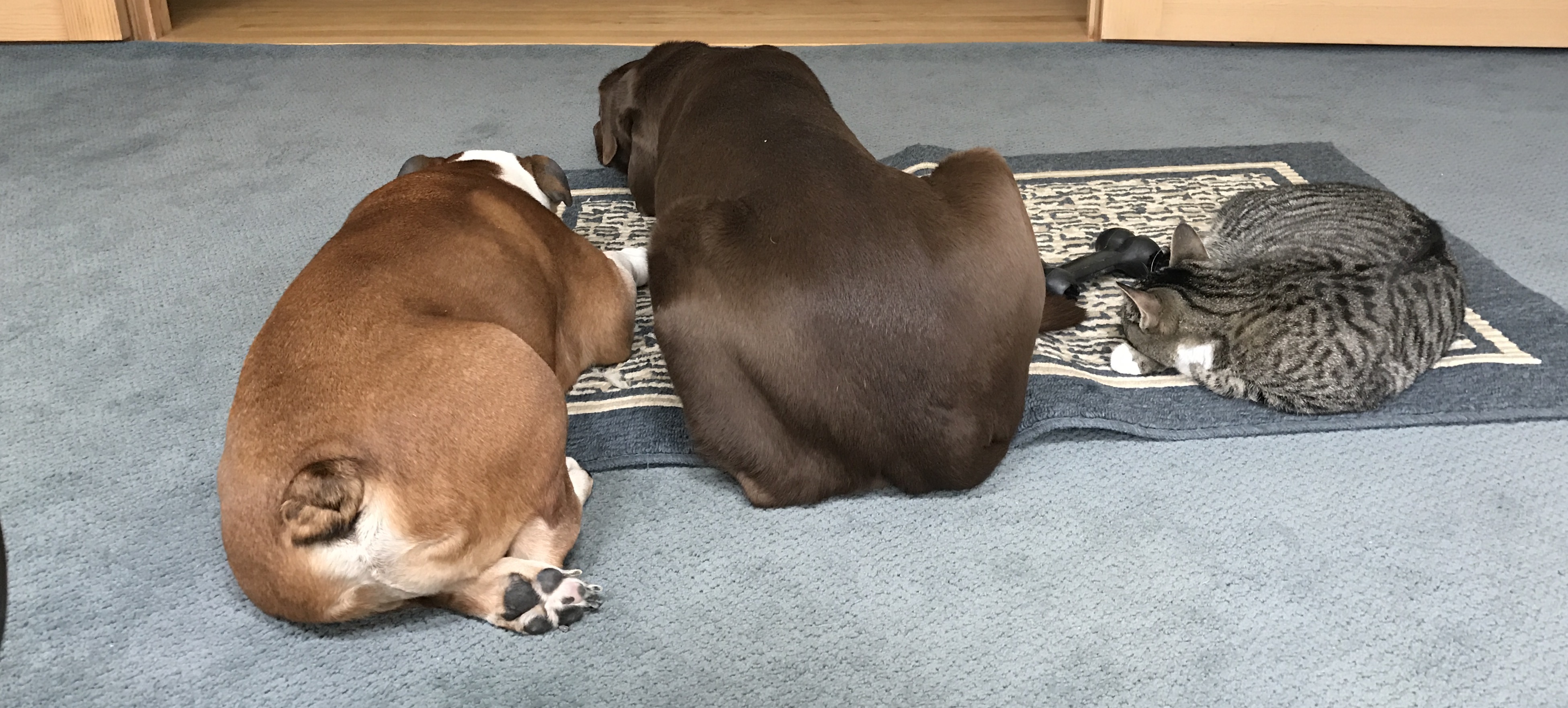
Jagged edges…

Well, the initial shock has mostly worn off and the enormity of how big a change a missing 17 pounds can be has begun setting in. 

I’ve moved on from one yawning pit of generalized loss to noticing the small changes – like closing my bedroom door all the way instead of using the contraption that keeps it propped open enough for a slightly chunky cat to enter and exit at will through the night. Remembering not to set out fresh breakfast and dinner or clean out the litter box has also presented a challenge.

The house is still strewn, of course, with toys, climbing towers, scratching posts, and all manner of other items now sitting idle. I haven’t had the heart to do anything at all with those. Since Maggie’s crate is still fully assembled in the laundry room, I don’t imagine clearing out any of this will be something I get after any time soon. File that under “too hard / do not want.”

Maybe the more challenging idea to get my head wrapped around is that Hershel was the living link back to Maggie and Winston – the youngster of the house while they grew into old age. Just by being, he connected me back to long ago days with my first pack when we were all so much younger.

Intellectually, I know each tomorrow will look just a bit better than the preceding day. Time will round over the jagged edges. Just now, though, those edges remain awfully raw… and if I’m honest, I’m in no way prepared for them to be smoothed. 

Sweet emotion…

I read a lot of financial news, but I’m the furthest thing from an expert in the field. I do it because I have a basic interest in how that part of the world works. When a guy says you should do X instead of Y, I like to have some basic understanding of the “why” behind the statement. If nothing else, I like to be able to ask intelligent questions when I don’t quite understand why things are the way they are.

Much of what I’ve been reading over the last few months is hammering the notion of fear in the market and the various behaviors that are being driven by it. It’s academically interesting enough, I suppose, but I feel like the discussion could be taken a step further. Emotion, not just fear, drives the market. I suspect it drives far more than that – and often enough it points people in a direction that isn’t particularly helpful.

I’m sure there are those out there who say they don’t feel emotions. I can only assume that a large percentage of them are lying, sociopathic, or a combination of both. There’s nothing intrinsically wrong with feeling the emotion – whether it’s fear, lust, joy – but people seem to get themselves into a world of trouble when they never get past the feeling stage. They dwell in it until whatever it is they’re feeling causes some kind of mental paralysis.  

There’s nothing wrong with feeling the full range of emotions. It’s inherently human, but I see very little good that comes from them being the master rather than just elements that serve the whole. Control is illusory, but I do think it’s entirely possible to manage your emotions, despite what the clips of people having public meltdowns on TikTok want us to believe.

Look, I’m not saying everyone needs to be an automaton, but maybe finding a way to channel some of the good and the bad into more reasoned and less knee-jerky responses to outside stimuli would be just a little bit helpful in going about the day. Not everyone needs to be a philosopher king, but swinging from pillar to post based on the market, the news, or life events feels like a damnably bad way to run a railroad.

Popular opinion is stupid…

America has a long history of rushing to judgment atop a wave of “popular” opinion. 

Witness the fiasco of NASCAR leading the charge against person or persons unknown who allegedly hung a noose in the pit area. There was a popular outcry, a swift investigation by the nation’s premier law enforcement agency, a hue and cry from talking heads across the spectrum that racism in that business must be plucked root and stem. Of course it turned out to be nothing more than a knot in a rope pull that had been there for at least a year. It was the very definition of nothing to see here, but it was hopped on by the professional and social media as the great scourge of the age. Talk about a lie getting, ‘round the world before the truth manages to get out of bed. 

At least we’re behaving true to form. Far better to commit to a spectacular, emotional response up front and early than to take the time to do the work of evaluating what’s really happening and decide on a practical, dispassionate response. 

It seems that if left to our own devices, we have a collective tendency to see enemies under ever bed – and respond in an emotional furor. As far back as the late 1600s, we were committed to knee-jerk reactions under pressure from the mob. Back there and back then something on the order of twenty men and women (and several dogs, if memory serves) were executed for practicing witchcraft. 

In the 1950s we were fond of seeing Reds around every corner. The coercive power of and individual destruction wrought by the House Un-American Activities Committee still stands as a testament to the utterly misguided means deployed when emotion, rather than logic serves as the basis of action. 

Here we are in 2020 once again revisiting past practice and seeing perceived evil at every turn. Because emotion is running at a fever pitch – drummed up by those who benefit most from chaos – we revert to a form older even than our republic. Then again, tearing down has always been easier than building – and the emotion of the mob will always be more appealing than putting in the dispassionate effort to determined how to get there from here.

We’ve been at it now for over three centuries later, for all our advancement, I sometimes wonder if we’ve really learned a damned thing.

Emoting…

I’m not a towering example of modern, overly emotional masculinity. I’m good at anger and its derivatives. I can even pull of contented without much trouble. The various subtile shades separating those two poles, though, mostly fall into the category of things that must be jammed down and best left unobserved by the outside world.

I had Maggie and Jorah out during my lunch break this morning. They were mostly out lazing around the yard – occasionally ginning up enough interest to chase off an intrusive bird or butterfly. Mostly they were content to lay around. I just happened to be looking in the right direction when Jorah plopped his chin down on Maggie’s back as they laid there in the sun. For the briefest of moments, it wasn’t Jorah I was seeing, but my dear old Winston. They’d laid in the same position for hours in the yard, looking out the sliding door, or piled together on the living room floor. It was the kind fo thing I’d seen a thousand time over the last ten years – but not once in the last six months.

It took my breath away.

At least it did before some dust or grit happened to blow into my eye and I had to struggle mightily not to make a spectacle of myself to any of the retired neighbors who happened to be nosy enough to wonder what I was doing home on a Monday. Even so, there may have been a little bit of emoting.

Winston’s been gone now almost seven months. The days are busy. The herd demands my attention. But there’s not a day that goes by when I don’t think of the snorting, shuffling bulldog who use to be with us. Most days now, it’s with a smile… though it turns out it can still be with big wet manly tears, too.

What Annoys Jeff this Week?

1. Intellectual inconsistency. As recently as a few weeks ago, the popular narrative was of police brutality, cops shooting unarmed citizens, and the racist tendencies of police departments across the country. This week the news is full of those arguing that only the police should have semi-automatic weapons. It stands to reason that if you think the police are a bunch of trigger happy racist jerks, they’re precisely the group of people you don’t want to have armed with “sophisticated weapons of war.” Then again, intellectual inconsistency isn’t so much of a big deal when your argument stems largely from a place of emotion rather than from logic, so there’s that.

2. Any given day. On any given day there’s no real way to tell what might be considered a priority by echelons higher than reality. There’s no reliable to plan for it, no way to prepare in advance for all possible topics of interest, and really no gauge for whether that particular thing will continue to be important the next business day. It makes for some interesting conversations with people going on for minutes sometimes without realizing they’re discussing too different things, but what it doesn’t do is make a good platform for getting anything done.

3. Office space. If you’re going to want to hold meetings about every single thing every single day, it might have been a good idea to plan on having more than two or three conference rooms for the thousand plus people you’ve poured into this fancy new building. At a bare minimum you should at least make sure your meetings end on time so the people showing up for the one scheduled to start immediately after yours doesn’t end up playing Tetris on their phones for thirty minutes while they wait for you to wrap up “just one more thing.”

Ladies lying about in ponds distributing swords is no basis for a system of government…

I’m generally considered a pretty smart guy, but I have never understood the thought process that goes on in the mind of chicks when they are making potentially life altering decisions. I’m a planner by habit as well as by profession and one thing I can say with a far degree of certainty is that “butterfly feelings” in the stomach area and how cute it was because he cried are generally not major planning considerations. In fact, I’d go so far to say that they are, in fact, a poor basis for any decision-making process.

Decisions of significance are made after careful analysis of the possible and likely outcomes, the severity of risks, consultation with subject matter experts, and a through “scrub” to make sure you are even asking the right questions. Without applying an overlay of logic to the process, decisions basically become “guesses.” And quite frankly, it has been my experience that life is far too short and time is far too precious to stumble from one point to another based on my best guess

I don’t mind dispensing advice; in fact I rather enjoy doing it. But please, ladies, when you ask, remember that I’m going to apply logical analysis to the situation rather than take stock in whatever butterfly effect you might be feeling. And if at some point one of you can explain to me what I’m missing here, please, please clue me in. I’m serious here people, I know there are a lot of you out there who read on a regular basis. I just want to understand what I am working with here. Can one of you dear readers enlighten me?

What separates us from the primates…

Authors note: This is not directed at any individual, living or dead. It is based on a series of observations over the last week. The use of the word “you” does not refer necessarily to “you” the reader, but more general “you” directed at the general public.

I’ve had two separate people tell me over the course of the last week some variation of the phrase, “you can’t always lead with your head.” I call bullshit. I call bullshit on the people who stumble blindly through life from one thing to the next because they’re “following their heart.” I call bullshit on people who turn left instead of right because “they have a feeling.” I call bullshit on a society that values luck over skill and mediocrity over greatness.

People, listen up, because your Uncle Jeff is only gonna go over this material one time. And yes, before someone asks, it will be on the test. Look in the mirror. Do you see that great big melon-looking rock sitting atop your neck? That’s your head. It’s where your brain lives. Your brain is useful for completing all sorts of tasks like addition, breathing, and general problem solving. Your brain, unlike that of say, a swallow, is well developed and provides you with the ability, when used correctly, to apply reason and intellect to even the most difficult of situations. The human brain has developed over millions of years to protect the rest of the body from writing checks that are too expensive to cash.

The ability to apply reason is what separates us from our primate cousins. It’s why we have built civilizations while they pick fleas off one another. I’m not saying that the heart or the spleen or the liver can’t be the point of inspiration, but it’s up to the brain to take that inspiration and flesh it out. It’s through reason that we come to understand the inspiration and impulses for what they are. It’s our intellect and our ability to make the hard decisions without getting waylaid that fundamentally makes us human.

Use your heart, or your intuition, or your ESP for all I care. But at the end of the day, try running things through your brain first before you declare the decision making process to be at an end. Try leading with your head for a change. You might be surprised.