Weekends, especially those that are too snowy, cold, and unpleasant for much else, are good times to ponder. Some, I’m sure, are eager to fill in every moment of the empty hours with active distraction, but I’m happy to spend them reading and thinking over a good brew up.
I had some delightfully long stretches of time to do just that over the past weekend. There was a single thought, though, that kept coming back to me and that’s that whatever we think of as “peace” simply isn’t the natural state of the world.
Europe was lulled into thinking of the “long peace” stretching from the end of World War II to the kickoff of Russia’s most recent misguided adventure in Ukraine. That’s only possible when you forget that Russia has been waging a low-intensity war in Ukraine since 2007. The countries that used to be Yugoslavia fell into brutal genocidal war in the 1990s. Before that, when there was still an Iron Curtain, the whole continent held its breath and armed itself with increasingly powerful tools of war.
The Cold War itself raged, from one degree or another, across South America, Africa, and Asia for half a century. None of that even takes into account the “big wars” of the 20th century, the wars for empire in the Victorian Age, or Napoleon’s setting all of Europe on fire in his wars of expansion in the 19th century. The 18th century could hardly be called peaceful, having birthed revolutionary fervor in both the United States and France. You can carry this line of thought back through the long sweep of history until you run out of written records to consider.
It’s why I chuckle any time someone earnestly tells me that if only there was X, Y, or Z, the people of the world would all live together in peace and harmony. Maybe if they’re the last two people on earth. Maybe. But I see very little evidence to convince me that when societies, cultures, and civilizations bumping up against one another, “peace” isn’t simply a momentary rest between stretches of open, brutal war.
Author Archives: jdtharp
An awful lot of time…
Sitting in the office all day gives you time to think.
It gives you time to think about smelling other people’s meals, and listening to their phone conversations, and their wandering around from cube to cube looking for an ear to bend, and the hour wasted traveling to and then another hour wasted going from that monument to early 20th century management philosophy.
Yes, sir, sitting in the office gives you an awful lot of time to think.
I’m quite sure there are people out there who are dying to get back to the office full time. God knows there will be plenty of senior leaders who can’t wait to get back to preening in front of town hall meetings and capacity crowds conferences – and seeing their toiling minions stacked elbow to asshole across whole floors filled with cubicles.
More than anything, though, sitting in the office is full of time to think about how utterly ridiculous it is to sit in an office when every single touch point of your day involves email, phone calls, and shuffling electronic information from one place to another. If you’re heart doesn’t seeth with just a little bit of rage knowing it could all be accomplished from any place on the globe with a reliable internet connection and a cell phone, well, I’m not entirely sure you’re thinking about work as a product and not as some kind of half-assed social activity.
As long as those running the show put as much or more premium on the quasi-social elements like maintaining a “corporate culture” and the farcical notion that “real” communication can only happen face to face, no amount of real world evidence seems likely to move the needle away from 1950s ideas of what working looks like.
There’s still no formal guidance on what the new and improved “return to work” plan will look like here in the belly of the bureaucracy. I’m told they’re working on an updated plan at echelons higher than reality. If precedent is prologue, I’ll expect this new plan to cleave as close as humanly possible to exactly how things were done in the Before Times and ignore as much as possible the last two years happened at all.
What Annoys Jeff this Week?
1. The United Nations. According to reports, the UN press office has instructed staff not to call the current Russian war against Ukraine a “war” or “conflict.” I’m sure somewhere, somehow the UN manages to do something useful, but I’m equally sure this ain’t it. Having spent the last two decades in the belly of one of the world’s great bureaucracies, I know ass covering when I see it. It’s not surprising from an organization that continues to allow Russia to chair the Security Council while simultaneously committing countless war crimes against clear and obvious civilian targets. It’s not surprising, but it’s damned well disappointing.
2. Our Arab allies. Leaders of both Saudi Arabia and the United Arab Emirates have refused phone calls from the President of the United States in recent weeks. These “allies” of ours are quick enough to pick up the receiver whenever the need to re-up an order of military hardware or need a big bad superpower to keep their neighbor in line. When the issue is opening up the spigot and pumping some more oil, tough, we’re met with a deafening silence. If we had any sense as a country it’s the kind of thing we’d remember and exact a price for the next time our allies need spare parts for their fancy American fighter jets.
3. Off ramps. The Twitter space is filled with voices calling for the world to find an “off ramp” for Vlad the Invader. The world, they say, needs to give Vlad a way to back away without smelling like he’s fallen directly through the outhouse floor. I’m sorry. No. Vlad needs to put his tail between his legs and slink back to Moscow having been bled militarily by a country he assumed would roll over and crippled financially by a resolute western alliance. The world will get far better terms once he squeals than if he’s allowed to thump his chest and claim some sort of victory no matter how pyric. Treat him like North Korea’s glorious leaders – put him in a box and mostly ignore him.
You have my interest…
When gas prices were at their previous all-time high, way back in 2008, I walked out of the local Toyota dealership in Memphis with a gas sucking 5.7 liter V8 Tundra. They had at least a hundred of them sitting on the back lot. They might not have been paying people to take them away, but it was awfully close. That original Tundra of mine came with four or five thousand dollars off sticker and 0% financing. They were just happy, it seemed, to get it off their books.
I knew then that the price at the pump was going to be painful, but not necessarily less painful than buying one of the small, fuel-efficient econoboxes that were flying off the sales floor. Sure, I was paying for fuel, but a pretty significant percentage of that was offset by the lower cost of the vehicle, “no cost” financing, and the preventative maintenance plan they threw in. As far as I’m concerned, I took my savings all on the front end of that deal rather than spreading it out over the life of the vehicle through lower fuel costs.
The same math doesn’t work in today’s environment. Getting into a new truck with the same trim level I’ve currently got comes with an eyewatering price, well above zero percent financing, and about a one mile per gallon improvement in fuel efficiency that does nothing to offset increasing prices. If I had to be in the market for a replacement vehicle right now, I’d be hard pressed to justify the purchase and operating costs.
I hope I’m not forced into a position of needing to replace a vehicle any time soon. In the meantime, I’ll be keeping an interested eye on the roll-out of more hybrid and all electric truck and SUV platforms. I always said I wouldn’t be interested in alternative fueled vehicles until they were every bit as comfortable for my fat ass as my big Toyota pickup. It feels like we’re nearing an inflection point where these options won’t be limited to “toy” compacts and bland sedans. True to my word, I’m beginning to get interested.
Three word mantras…
If I’m honest, finding something relevant to drop here every day is getting to feel a bit like swimming against the tide. Sure, I’ve got opinions about damned near everything, but I’m not a foreign policy expert. I’m not an Eastern Europe expert. I’m not an economist. Even though I studied political science, most days I even struggle to get my arms around what American domestic politics has turned into in this stupid century of ours. The way I learned to understand the world is often enough no longer the case or impolite to say out loud.
The best I can manage is trying to take in information from people who are experts in a wide array of fields and try to filter those through my own philosophical and, yes, ethical, lens. I like to think I hit more right notes than not, but the only real way of telling will be looking back here in 20 or 30 years and seeing how it all turned out.
All I feel particularly competent to guarantee at this point is that I intend to keep grappling with events in a legitimate effort to understand the world around me. Here, if nowhere else, it will never devolve into grand over-simplifications like “Orange man bad,” or “Let’s go Brandon.” The world is entirely too complex to be distilled down into three word mantras. I’ll call the balls and strikes as I see them based on as much intelligent commentary and information as I can get my hands on at the time.
A needed pause…
I’ve been swallowing news in big gulps since Vlad the Invader sent his wanna-be Red Army across the Ukrainian boarder. Cable, streaming, social media, and blogs, I’ve been trolling all of them for snippets of new and interesting information.
That’s one of the dangers of being a history guy… and one that’s spent a fair amount of his time concentrating on a combination of general war in Europe and the cold war. Throw in a hefty dollop of defense policy and global strategy and, well, it can be downright hard to tear your eyes away, for fear of missing whatever news happens to break while you’re looking somewhere else.
I won’t deny being keyed up by the flow of information available in the open-source environment. I’ve lost track of the number of “holy shit” moments. It would be entirely too easy to follow the rabbit hole down into something not entirely healthy.
Knowing that about myself, I’m going to try to step away a bit – even if it’s just for tonight. I’ll be doing my best to stay the hell off Facebook and Twitter and all the other sites and slip into a comfy chair with a good book. It’s 100% an effort to blow out a week’s worth of accumulated gunk from the darker corners of my head.
Taking a night off from the war is a luxury our friends in Ukraine don’t have. I might be tuning out the news for a few hours, but I’m sure it, and the overall state of this old, beshitted world of ours, won’t be out of my thoughts for very long.
What Annoys Jeff this Week?
1. Sanctions. There’s a small chorus out there arguing that the fairly dramatic sanctions regime imposed on Russia is only hurting Russian civilians, that it’s somehow “unfair,” or that it’s somehow an escalation of this conflict. I tend to come at it from a much different perspective. Russia’s wholesale invasion of Ukraine is a clear and present threat to the post-World War II free and democratic order in Europe. Under the circumstances, marshalling the full economic might of Western Civilization and arming the Ukrainian resistance with as much material as they can carry feels like the very least America and western Europe can do in response. I can assure you, a President Tharp would be far less ginger in how he approached the whole damned mess.
2. Saber rattling. The nuclear option. Vlad the Invader has put Russia’s nuclear forces on alert. Feels like the good old days of the Cold War when Soviet leaders threatened nuclear apocalypse any time world events didn’t go their way. If you didn’t live through those times, it happened a lot. Like all the time. If we caved in to Russian nuclear threats every time they stomped their feet in a fit of not getting their way, there would still be a wall in Berlin and an Iron Curtain across continental Europe. As the poet said, there are worse things in life than being dead.
3. Propaganda value. I’ve loaded down my social media feeds with images, memes, videos, and commentary on Russia’s war-making over the last week. One thing I’ve refrained and will continue to refrain from doing is posting any of the images of surrendered Russian soldiers. I instinctively recoil every time I’ve ever seen pictures posted of American troops in the hands of the enemy… and seeing what are almost inevitably young conscripts on what must be the absolute worst day of their life being put on display, while it may have a certain propaganda value, doesn’t sit well with me. Better to just march them off to confinement and confirm through the Red Cross that Ukraine is committed to treating its POWs with dignity and in accordance with the Geneva Convention.
At the top of the list…
I’ve been fortunate to go many places and do many things over the years. I’ve managed to scratch out a fair number of “bucket list” items. There’s still a number of things still on the list, of course. If you’re doing it right, it’s the kind of list that probably should be inexhaustible.
There is one item currently standing undisputed at the top of the list. When all this is over, I want to go to Ukraine. It may take me a while to sort the hows and whats, but I want to stand on that ground and look these remarkable people in the eye. I want to tell them that they’re inspiring and absolutely magnificent in the face of the most grave possible danger. They’re patriots and heroes.
I like to think that says something coming from a guy who’d rather not leave the house, let alone cross oceans and continents.
Mother Russia…
Russia rattling its nuclear saber and its foibles being the butt of jokes is honestly just more fuel for the way back machine. If you didn’t listen too carefully to the news over the last few days, I think you could be forgiven for wondering if you woke up sometime in 1985. New faces, new flag, but the same old, worn playbook of threats played out against the backdrop of an economy teetering on the brink of collapse. The only difference this time is in the internet age, the entire world can see the rot and dysfunction in Russia when back then it was largely hidden behind the iron curtain and a wall of silence.
For all his bluster, Mr. Putin can’t hide that his country is a shambles if not an outright sham. Seventy years of Soviet policies followed by 30 years of kleptocracy apparently don’t build up a productive and vibrant system. Who would have guessed, right? I, of course, mean aside from anyone who was alive to watch the Soviet Union collapse under the weight of its misguided and misbegotten policies.
I don’t in any way intend for this to sound triumphant, because I know well enough that even a tired, sick, and old elephant hurts if it happens to fall on you. The takeaway, though, is that we need a full reevaluation of how we think about Russia and Russian power in the future. We should also use this brief period of western democratic ascendency and unity to put as much of our own house in order as we can while it lasts. Putin or no Putin the world is a dangerous place that’s markedly more well ordered when its great democracies aren’t busy bickering among themselves.
Information worth knowing…
For the last few years, I’ve been using Goodreads to manage my personal library. It’s a solid app, filled with reasonable functionality, and absolute scads “social” elements for readers and tie ins with most of the popular social media platforms. For basic cataloging, it filled the bill without much trouble. Still, at its heart, Goodreads is a social media platform and I found it increasingly limited when trying to tweak my ever-increasing pile of books.
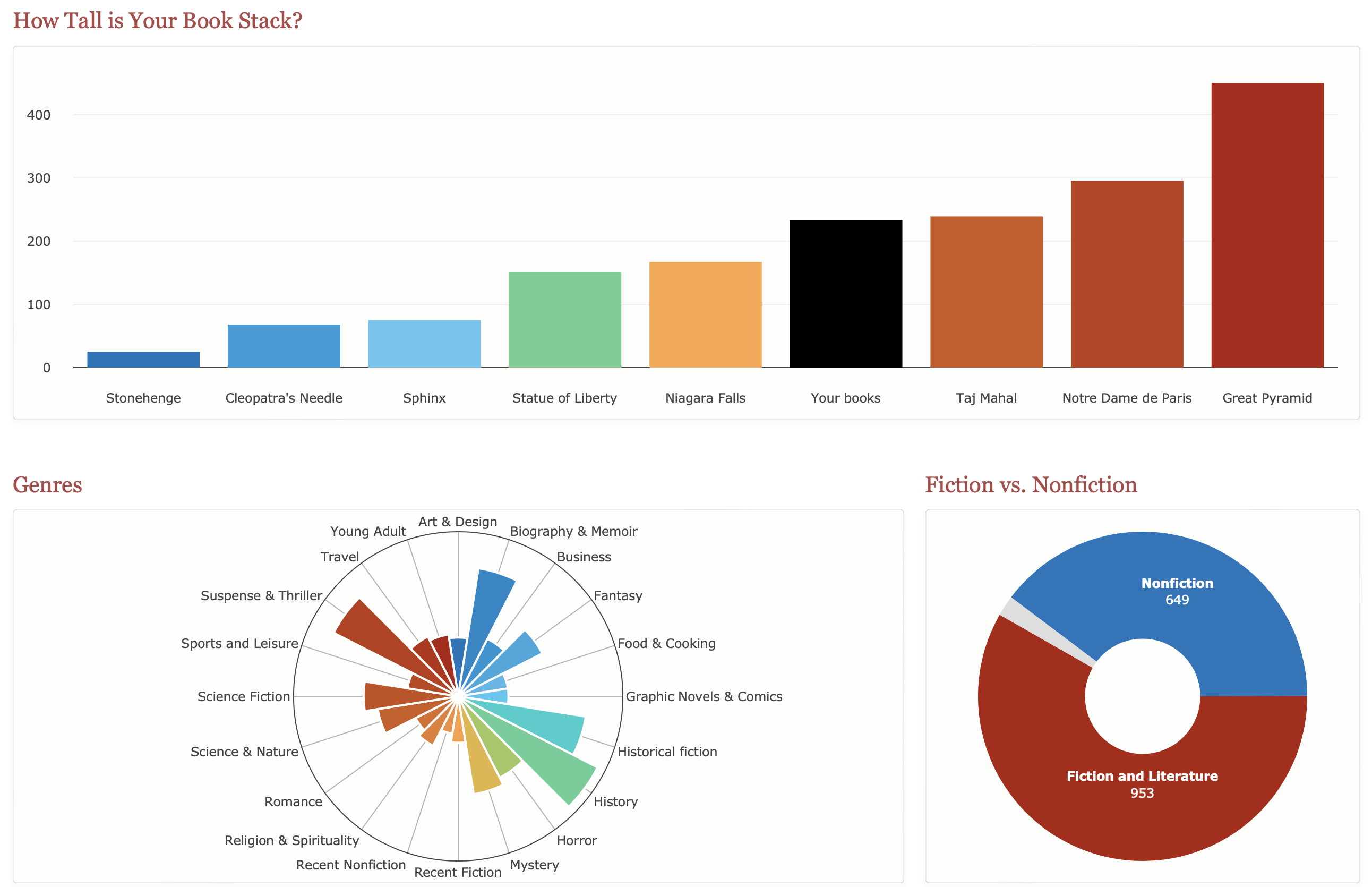
Over the last couple of weeks, I’ve been slowly transitioning over to LibraryThing and working through how to catalog and manage the books over the long term. I’ve finally gotten most of the basics covered – or at least got things broken down into the primal chunks. What I’ve read (763), what I have on the to be read pile (657), and what I still want to get my hands on in the future (207). The latter bit is certainly not an exhaustive list, but it will help me be a bit more selective and targeted as I hunt books in the future.
The next step is taking those big chunks and starting to build a little more granularity. Being able to drill down into more detail than just “History, Britain,” will be when I get an itch for something from a specific time period or topic. Getting the details sorted, though, looks like a project that could easily take months or years as I pick at it in free moments. Getting the level of detail I’d like to have will mean moving past the bulk edits of the last few weeks and dealing with smaller subsets and even individual touch points. It’s going to take time, but it feels like I’ve finally stumbled on a proper cataloging tool to really start getting a grip the collection from top to bottom.
Yes, it’s probably overkill, but I have every expectation that this bunch of books will continue to grow over the next 20-30 years. Coming to terms with how to keep it all straight (and avoid buying duplicates) feels like a worthwhile endeavor. Plus, if I hadn’t made the transition, I wouldn’t know that my stack of books is now just slightly shorter than the Taj Mahal. That’s information worth knowing.
 JEFFREYTHARP.COM